
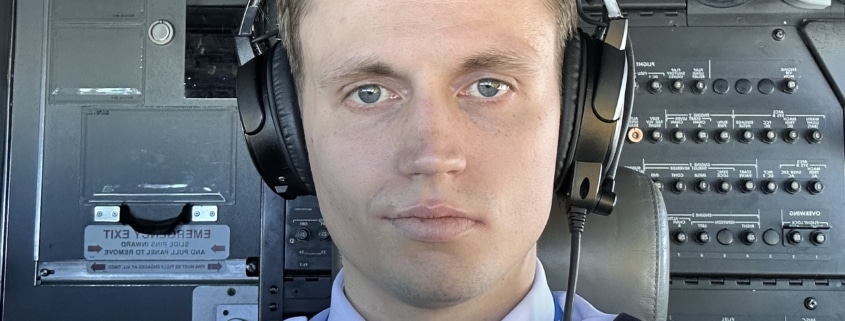
Eero Jyrkkiö
Who are you, where do you work, and what do you fly for a living?
I’m Eero Jyrkkiö and I currently work for the Royal Dutch Airline, KLM. The aircraft type I fly is the Boeing 737, which is used to operate KLM’s European flights.
How did you originally become interested in flying?
My interest in flying started when I was young, traveling to different countries with my parents, which made air travel and airports familiar to me. But the idea became concrete in my second year of upper secondary school, when I had to start thinking about what I wanted to do after graduating. University wasn’t my first choice, because I wanted to do something concrete and hands-on, while also challenging myself intellectually.
What made you apply specifically to Aeropole’s airline pilot course, and what was most memorable about your studies?
I applied to Aeropole because it let me start the commercial pilot course very quickly, and the courses could be tailored to fit individual schedules. The modern Diamond fleet also influenced my decision, since I wanted to study on modern, high-quality aircraft.
What has stuck with me most from studying at Aeropole are the trips abroad we took during our studies — for example, when we spent a couple of weeks in Denmark, and during the CPL phase spent a couple of nights in the Baltics. Those were unforgettable trips.
How quickly did you find work after graduating?
I graduated in the summer of 2022, right in the aftermath of COVID. Air travel was only just starting to recover, so as a newly graduated pilot, finding a job wasn’t exactly simple. About a year after graduating, almost to the day, I started my first job as a commercial pilot at Ryanair. I worked there for a year and a half, based in Stockholm and Marrakesh. In the autumn of 2024 I applied to Finnair and got in, but Finnair then entered change negotiations, which meant the job no longer existed. I started at KLM in December 2025.
What was the hiring process like at your current airline?
KLM’s hiring process is fairly similar to that of many other major airlines. It’s a long process with several different stages.
I sent my application to KLM in the spring of 2025, after which I was invited to complete online tests. After the online tests, I got an invitation to Amsterdam for in-person aptitude and ability tests. After that, I waited a while for an invitation to the simulator test and interview.
After the interview, I quickly found out that it had gone well. Then, in December 2025, I started working at KLM.
What’s the best part of being a commercial pilot?
The best part of a pilot’s job is that every day is different. There’s a good balance between routine and improvisation. Certain things are always done precisely according to set procedures, but at the same time you run into situations where you need to apply judgment and use your own problem-solving skills. On top of that, the job involves close teamwork with other people, which adds its own important and interesting dimension.
What advice would you give someone dreaming of a career as a pilot?
If we’re talking about someone still in school, first finish school properly. A solid foundation in math and physics, along with fluent English, provides a good base for a pilot career.
It’s also worth preparing for the fact that a pilot’s career path doesn’t always go in a straight line. So it pays to be patient and ready to adapt to changing circumstances.
Most important, though, is to have a genuine interest in the field, be willing to learn new things, and be ready to work toward your goal. It’s also good to remember that you don’t need to know everything right away, and you don’t have to be some kind of superhuman to become a pilot.
If someone is considering applying to commercial pilot training, how would you advise them to prepare for the application process?
First of all, be yourself. That goes a long way in the aviation world — both when applying for training and later in working life.
For the application process, it’s also worth brushing up on the basics, especially mental math and maybe the fundamentals of physics too. That said, you don’t need to master everything perfectly. What matters most is having a solid grip on the basics and having genuine motivation to learn and develop.
To finish, a few quick questions: day or night flying? Short-haul or long-haul? Instrument flight rules or visual flight rules?
Day flying, short-haul (since I haven’t flown long-haul) — and this one’s difficult… visual flight rules.
Is there anything else you’d like to say?
Maybe one more thing I’d like to mention is that, as a Finn, pilot circles are a fairly tight-knit and pleasant community. That really stands out especially when working abroad. Even if you don’t already know someone, you can very often find a mutual acquaintance.
I’d also like to wish good luck to everyone considering this field, currently studying, or already working in it. This is truly a wonderful profession. It takes a lot of work and effort, but I think it’s worth it.
